A taste profile is a map, not a score
People often describe a cheese as simply mild, strong, creamy, or sharp. Those words are useful, but each one hides several sensations. A cheese can be salty without being very aromatic, creamy yet acidic, or firm while carrying a long, savoury finish. A taste profile separates these signals so that two cheeses can be compared with more care.
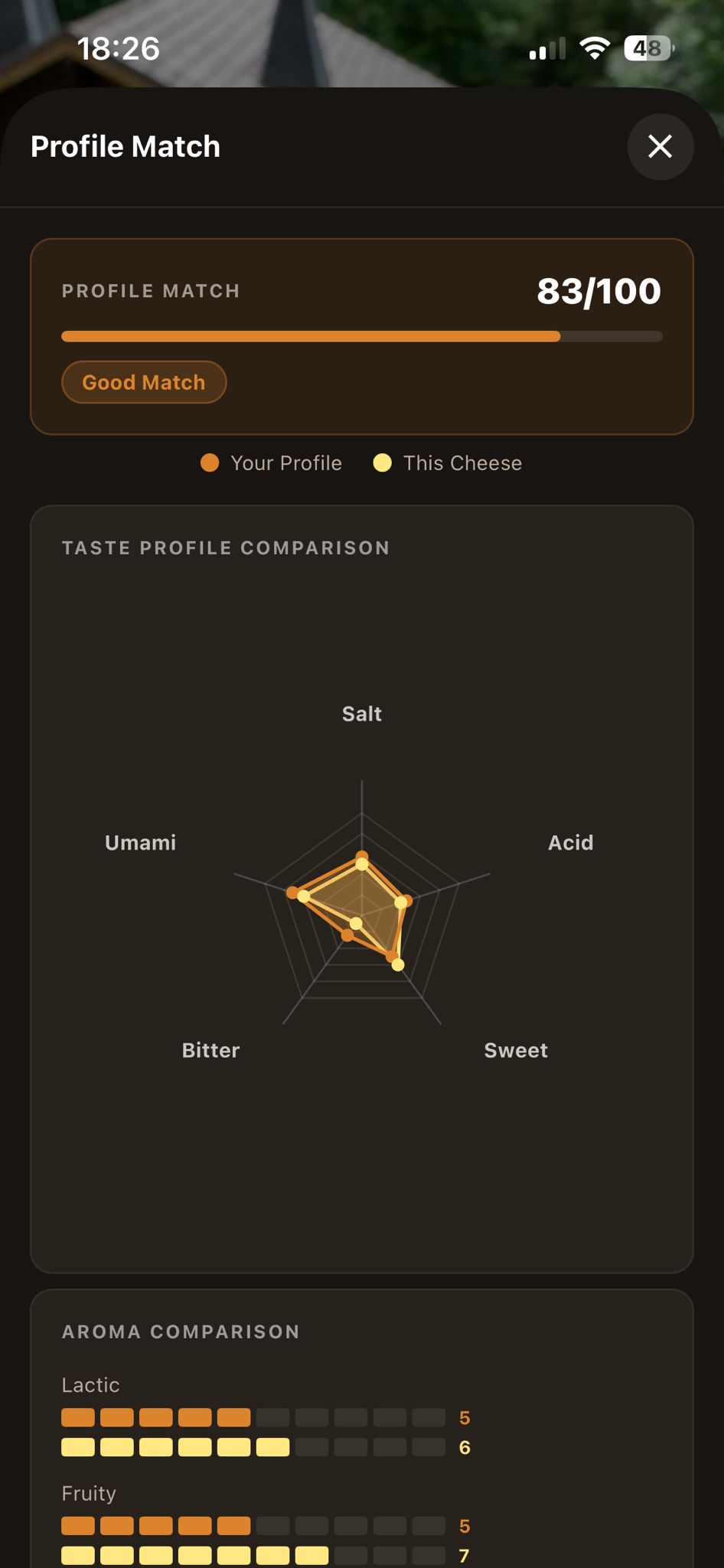
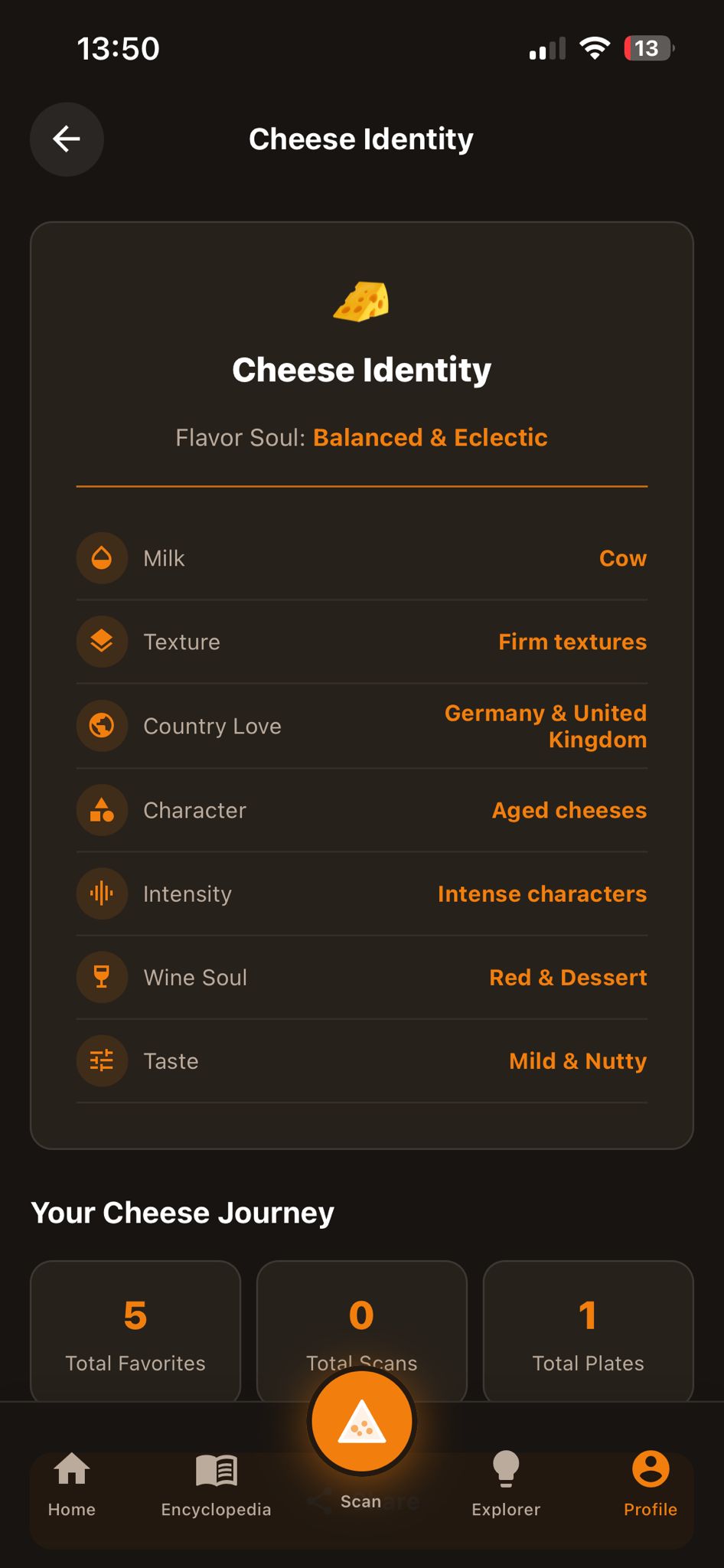
Cheesepedia gives every cheese a baseline profile built from its style, production context, and sensory character. Your personal profile is different: it develops from the cheeses you save, compare, and enjoy. Matching the two helps answer a more useful question than “Is this a good cheese?” It asks, “How is this cheese likely to meet my palate?”
The five taste axes
The tongue registers five basic tastes. In cheese, they rarely appear alone; their balance changes with milk, cultures, moisture, salt, ageing, and rind development.
- Salt: immediately noticeable in brined cheeses, blues, and many aged styles. Salt can sharpen flavour and lengthen the finish.
- Acidity: the bright, tangy sensation common in fresh goat cheese, cultured dairy, and younger cheeses. It often makes a cheese feel lively.
- Sweetness: usually subtle rather than sugary. It may read as fresh milk, caramel, cooked cream, or a gentle rounded finish.
- Bitterness: a restrained bitter edge can add complexity, especially near a rind. Too much may feel harsh or unbalanced to some palates.
- Umami: the deep savoury quality that becomes prominent in many matured cheeses as proteins break down during ageing.
A radar chart makes these relationships visible, but the shape is not a laboratory analysis. Cheese changes with age, batch, producer, storage, and serving temperature. The profile is a structured sensory baseline for comparison.
Aroma, texture, and intensity complete the picture
Two cheeses can share similar salt and acidity while feeling entirely different. Aroma adds families such as milky, buttery, grassy, nutty, earthy, mushroom-like, animal, smoky, or spicy. Texture adds another layer: crumbly, elastic, fudgy, creamy, dense, open, crystalline, or runny.
Intensity describes how strongly the overall experience arrives and how long it stays. It is not the same as quality, and it is not always linked to firmness. A soft washed-rind cheese can be more aromatic than a hard, young cheese. Likewise, a mature hard cheese may feel concentrated and savoury without being pungent.
Higher acidity, gentle salt, a moist texture, and clean milk or herb aromas.
Creamy texture, lower perceived acidity, buttery aromas, and medium intensity.
Pronounced umami, a dense or crystalline texture, nutty notes, and a long finish.
Strong rind, earth, spice, or blue-mould aromas with a more assertive finish.
How does a personal taste profile form?
A useful profile needs more than one favourite. If you only save creamy cheeses, the system sees a narrow slice of your palate. Exploring different milk types, textures, countries, and intensities gives it better contrast. A cheese you dislike can also be informative when you can name what bothered you: excessive bitterness, a dry texture, a strong animal aroma, or simply too much salt.
Preferences also move. Season, occasion, accompaniments, and experience can change what feels appealing. Cheesepedia therefore treats your Cheese Identity as an evolving pattern rather than a fixed label.
Use your profile to discover, not to stay in a bubble
The safest recommendation is not always the most interesting one. A close match can help you choose confidently at the counter. A slightly more adventurous match can introduce a new texture or aroma while keeping other familiar qualities in place. This is where taste intelligence becomes a sommelier assistant rather than a static preference filter.
In Cheesepedia, you can compare your profile with a cheese, compare two cheeses directly, and use those insights alongside pairing and recipe tools. The website explains the sensory language; the app brings it together with your own history and preferences.
Frequently asked questions
Can a taste profile tell me exactly which cheese I will like?
No. It estimates compatibility from sensory characteristics and your saved preferences. Producer, maturity, serving temperature, context, and curiosity can still change your experience.
Is a strong cheese always more bitter or salty?
No. Intensity describes the overall sensory impact. A cheese may be highly aromatic, deeply savoury, or very persistent without being especially bitter or salty.
Does my Cheesepedia taste profile change over time?
Yes. As you explore, save, and compare more varied cheeses, your Cheese Identity can develop with your palate rather than remaining a fixed label.
Sources and further reading
This guide is Cheesepedia's original interpretation of the references below. Listing a source does not imply that the organization endorses Cheesepedia.