Begin with the occasion, not the cheese counter
A board served before dinner should feel different from one that is the main event. Start by asking who will eat it, when it will be served, whether there are dietary limits, and whether guests already enjoy assertive cheeses. Budget and availability matter too. A smaller board with a clear idea is usually more satisfying than a large board assembled without rhythm.
If guests are new to cheese, make most of the board approachable and give one position to discovery. For experienced tasters, widen the contrasts and include a cheese with a more distinctive rind, milk, or maturation style.
Choose contrasts people can actually taste
Build the core of the board across texture and intensity. One fresh or soft cheese brings brightness; one creamy or bloomy-rind cheese adds richness; one firm or aged cheese brings concentration; and one more aromatic style can create a final point of contrast. This is a framework, not a compulsory checklist.
Milk type, production method, and region can add interest, but labels alone do not create balance. Two cheeses from different countries may still feel nearly identical. Read their actual sensory profiles and look for a change in texture, aroma, salt, acidity, or finish.
A young goat cheese, fresh white cheese, or delicate stretched-curd style gives the palate a clean starting point.
A bloomy rind or soft, rich cheese introduces a fuller texture without necessarily becoming very intense.
An aged hard cheese adds umami, nuttiness, crystals, and a longer finish.
A blue, washed-rind, smoked, herbed, or cave-matured cheese can finish the sequence with personality.
Give the board a tasting direction
Arrange cheese from delicate to intense so that one powerful bite does not mute everything after it. A useful flow moves from fresh and mild to creamy, firm and mature, then aromatic or blue. This order can be shown physically from left to right or with small labels.
Give each cheese enough space and, where practical, its own knife. Cut a few opening portions so guests understand how to approach each shape, while leaving enough intact for the cheese to retain moisture and character.
Let accompaniments support, not disguise
Bread and neutral crackers reset the palate. Fresh or dried fruit can add acidity or sweetness. Nuts bring texture, while honey, preserves, or chutney can create contrast for salty and mature cheeses. Pickled elements introduce brightness but can dominate delicate styles, so use them deliberately.
Drinks should follow the same balance. Wine can be chosen through acidity, sweetness, tannin, body, and aroma. Non-alcoholic options can work through sparkling acidity, tea tannin, fruit, botanicals, or roasted notes. Water should always be available.
Prepare the practical details
Buy enough to feel generous without guaranteeing waste. The right quantity depends on whether cheese is a taste, a starter, or the meal itself. Ask your cheesemonger to portion for the role it will play. Keep cheese refrigerated according to its label, then bring out only what you plan to serve so it can open up without sitting warm for longer than necessary.
Label allergens and milk types when they matter, keep raw-milk information visible, and do not let shared knives carry blue mould, chutney, or nuts across the entire board. A calm layout is easier to enjoy and safer to navigate.
Turn a good board into your board
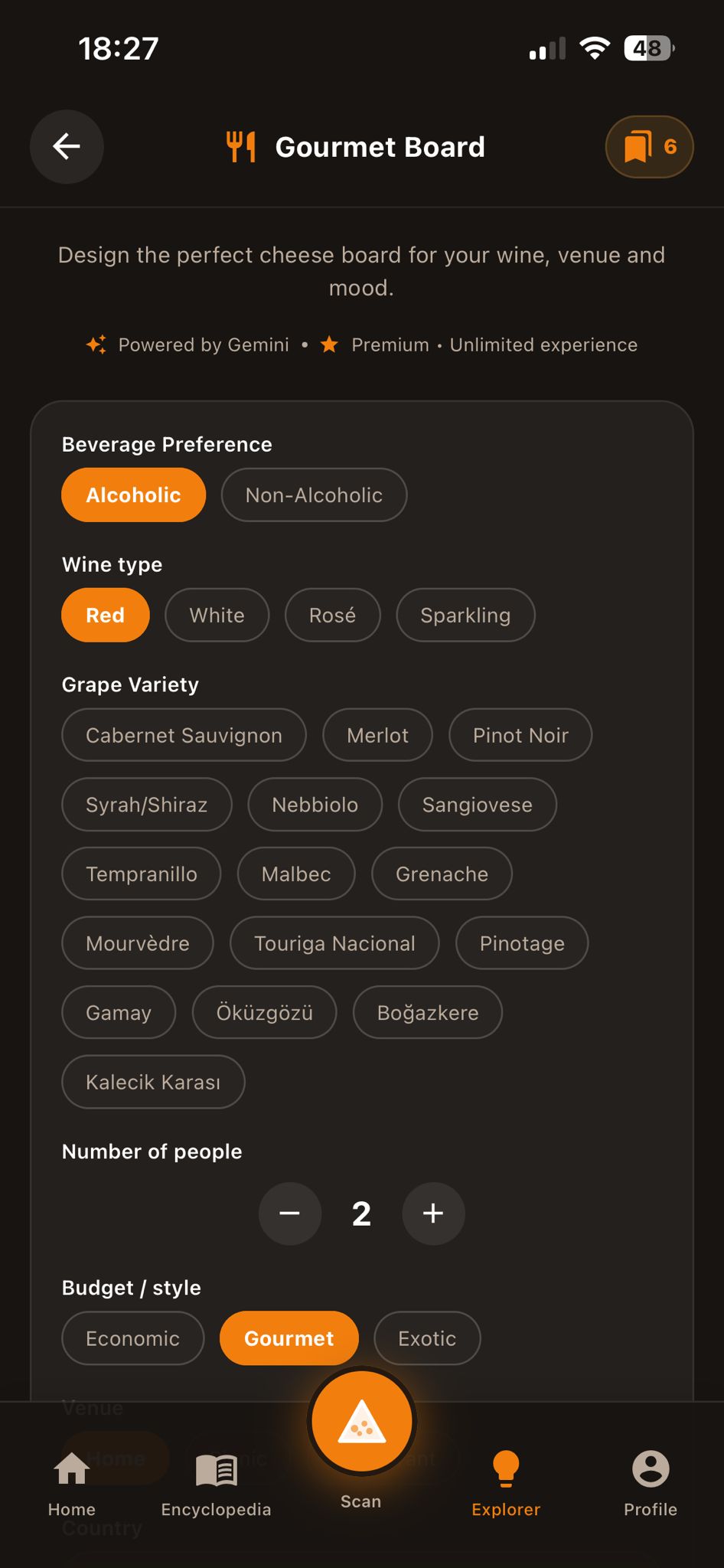
Classic board formulas cannot know whether your guests prefer bright goat cheese, buttery Alpine styles, salty blues, or mild textures. Cheesepedia's Gourmet Board adds that missing context. It uses Gemini to generate a board from your drink choice, party size, budget or style, venue, and mood. It is a separate AI-powered planning tool; Cheesepedia's core cheese and wine pairing engine uses expert-designed algorithmic rules rather than generative AI.
The result should still be treated as a plan you can adapt to local availability and dietary needs. The website gives you the principles; the app turns them into a board for the evening you are actually planning.
Frequently asked questions
How many different cheeses should a board have?
There is no mandatory number. Three to five clearly different styles usually create a useful tasting journey without crowding the board, but the occasion and number of guests should decide.
Should cheese be served straight from the refrigerator?
Very cold cheese may feel firmer and less aromatic. Bring out only the amount you plan to serve and follow the product's food-safety instructions rather than relying on one universal timing rule.
Does the Gourmet Board only work with wine?
No. Cheesepedia supports both alcoholic and non-alcoholic routes and uses the wider occasion, guest count, budget, venue, and mood to shape the board.
Sources and further reading
This guide is Cheesepedia's original interpretation of the references below. Listing a source does not imply that the organization endorses Cheesepedia.